
Port electrification: a strategic shift that is already happening
Port electrification: a strategic shift that is already happening

EU regulation now requires all major European ports to provide shore power by 2030. That might sound far away, but it isn’t. Infrastructure projects of this scale can take two to three years to complete, and today’s decisions will determine whether your port is ready in time or left behind. Across Europe, port operators and shipowners are already making moves, not just to comply but to stay competitive in a rapidly changing market.
Key takeaways
- Maritime transport accounts for around 3% of global CO₂ emissions, with the strongest impact in port cities.
- The EU’s Alternative Fuels Infrastructure Regulation (AFIR) makes shore power mandatory at major ports by 2030.
- Shore power is a complex infrastructure challenge, requiring substations, frequency converters, high-voltage cabling and standardised ship connections.
- Equans has delivered a 48 MVA shore power station in Marseille: three ships powered simultaneously via 16 transformers and 60 km of cables.
1. Why ports need to electrify
Ships in port still impact the cities around them
When a cruise ship or cargo vessel is docked, it keeps its engines running to power onboard systems, such as lighting and air conditioning. This releases nitrogen oxides, fine particles, sulphur dioxide and other pollutants directly into the surrounding city, contributing to poorer air quality for local communities. As a result, there is growing pressure from local authorities and the general public to reduce these emissions.
However, for port operators, this is no longer just an environmental issue. It can also directly affect operations and compliance status, not to mention the company’s reputation.
Maritime transport carries more carbon weight than it appears
Globally, shipping accounts for around 3% of CO₂ emissions, roughly equivalent to the entire carbon footprint of Germany. That figure is set to grow as world trade volumes increase. However, the good news is that a significant proportion of these emissions can be avoided simply by switching ships off while they are in port.

“ Decarbonising means first reducing energy consumption, then electrifying end processes. In transport and industrial heat, that is where the real levers lie. ”
The EU has set a hard deadline: 2030
The Alternative Fuels Infrastructure Regulation (AFIR), adopted in 2023, requires all major European ports to offer shore power to docked vessels by 2030. This is binding EU legislation, not just a recommendation. Ports that miss this deadline will face penalties and, more importantly, risk losing business to competitors who are already compliant.
What is the AFIR?
The Alternative Fuels Infrastructure Regulation is an EU law requiring major ports to provide an onshore power supply (OPS) for container ships and cruise vessels by 2030. It sits within the Fit for 55 package, the EU’s plan to cut greenhouse gas emissions by 55% by 2030.
Electrification of transport is reshaping energy demand
Global electricity demand is growing by nearly 4% a year, driven mainly by the increased use of electric vehicles and now maritime transport. Battery costs have dropped sharply, making electrification increasingly more viable across the transport sector. Therefore, ports that move early will secure better grid connections, while those that wait will have to compete for scarcer capacity later.
2. What does port electrification actually involve?
Cold ironing: cutting the engines while in port
Shore power (also called onshore power supply (OPS) or cold ironing) allows a ship to connect to the local electricity grid and shut down its diesel generators. As a result, emissions drop to zero while the vessel is in port. On the face of it, it seems like a simple concept. But delivery is far from straightforward.
Where does the term “cold ironing” come from?
In the past, ships had coal-fired engines. When a ship stayed in port long enough for its engines to cool completely, the iron engines would cool down, hence the term “cold ironing”. Since then, the term has stuck. Today it describes any shore-based electrical supply to a berthed vessel. Ships spend roughly 20% of their operating time in port, so this is one of the most accessible ways for the maritime transport sector to decarbonise.
It’s not a charging point. It’s industrial energy infrastructure.
An onshore power supply is less like a plug socket and more like a small power plant. It includes:
- High-voltage substations to connect to the grid
- Power transformers to adjust voltage levels
- Frequency converters
- Kilometres of cabling through an active port
- Standardised ship-side connection panels
Of course, delivering this in a live port environment requires extensive technical expertise, but it also requires detailed planning and coordination, not to mention experience.
The hidden constraint: 50 Hz vs 60 Hz
European grids operate at 50 Hz, while around 80% of the global fleet is built for 60 Hz. Without conversion, plugging a 60 Hz ship into a 50 Hz supply can damage onboard equipment and systems. As a result, frequency converters are not just an optional extra, and underestimating their importance can lead to cost overruns further down the line.
What is “Hz”?
Hertz (Hz) is a measure of frequency of how many times per second an electrical current changes direction. European power grids operate at 50 Hz, while the North American and Asian standard is 60 Hz. As a result, electrical devices are normally designed for one or the other. A mismatch can result in overheating and ultimately cause the device to break. This means that every European onshore power supply serving international ships needs a frequency converter, full stop.
One standard to connect them all: IEC/ISO/IEEE 80005
For onshore power to work at scale, it must be possible for any ship to connect at any port. This requires a shared technical language with regards to connectors, protocols, voltages and currents and safety procedures. This is where the IEC/ISO/IEEE 80005 standard comes in. Shipping companies simply will not retrofit their vessels unless they trust that compliant ports exist to welcome them.
3. What this looks like in practice: Equans in Marseille
One of Europe’s most ambitious shore power projects
The port of Marseille receives hundreds of cruise ships every year. Equans was contracted to deliver a complete shore power system for the cruise terminal, from initial design to final commissioning.
This is what it looks like in figures:
Project scope
48 MVA
Conversion station capacity
3 ships
Powered simultaneously
60 km
of high-voltage cables deployed
Equipment installed
16 transformers
Weighing up to 32 tonnes each
120 circuit breakers
Safety and power distribution
50 Hz → 60 Hz
Frequency conversion
Project delivery in a live environment
Behind these figures lies the real challenge: installing heavy-duty electrical infrastructure in an active cruise terminal while ships are still calling, without disrupting operations. In this situation, experience, safety, planning and logistics capabilities are just as important as the engineering expertise.
“ This project gives real meaning to our work, because it will improve air quality in Marseille ”
A rapidly growing market
Marseille is just one project among many. Regulations are pushing every major port in Europe towards electrification, and the same is playing out across the shipping industry in North America and Asia. The shore power market is expanding fast, and the projects in the pipeline are getting larger. For ports, electrification is no longer a question of “if”, but “when” and “how fast”.
4. The real obstacles and how to get past them
The 50 Hz / 60 Hz mismatch is the single most underestimated cost item in European port electrification. Any project that skips a rigorous conversion sizing study early on will pay for it later in the form of overruns and performance issues.
A single large cruise ship can draw several megawatts of power. Several ships at once can draw the equivalent of a small industrial district, and this can be quite a shock for the local power grid. In practice, this means significant ramifications for grid capacity. Without careful impact studies and reinforcement works, you risk destabilising the network. This kind of preparation cannot be left to the last minute.
Implementing a fully electrified terminal can easily run into tens of millions of euros. But the alternative is not free. AFIR non-compliance carries penalties, and shipping lines are already taking electrification into account when selecting ports. Long-term energy savings tip the balance further. EU funding, such as the Connecting Europe Facility and national green infrastructure programmes, can also reduce the net outlay significantly.
Shore power is only scalable if every port and every ship can connect without the need for bespoke workarounds. This means consistent application of IEC/ISO/IEEE 80005 across equipment manufacturers, port operators and shipowners. Consistent application of the standard across equipment, ports and vessels is therefore essential to ensure reliable and interoperable shore power systems.
The time to act is now
2030 is four years away, but infrastructure projects take time. Grid connections take time. Engineering takes time.
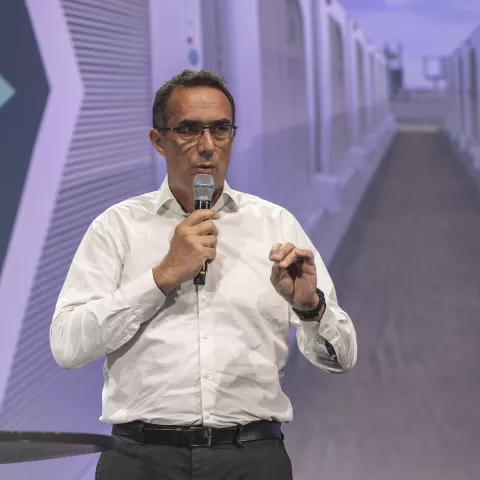
As Jérôme Stubler, CEO of Equans, puts it: “By electrifying industrial heat and transport, Europe can go much further than any other region. Decarbonisation will be a source of economic gains and genuine energy independence.” Port electrification is part of that story, and it is already happening.
The ports that will be ready are those that start now. And those that succeed will not do it alone but with partners who have already delivered projects at scale. Equans has, and can bring that experience to every new port electrification project.
Is your port ready for 2030?
Whether you are at the feasibility stage or ready to build, Equans brings the end-to-end expertise to design, deploy and commission your shore power infrastructure.
Talk to our experts: equans.com/expertises/electrical