
Transport electrification: powering sustainable mobility across ports, rail and roads
Transport electrification: powering sustainable mobility across ports, rail and roads

The transition to smart mobility demands innovative approaches for businesses and communities to move people and goods. Transport electrification rapidly transforms every sector, from bustling ports and railways to motorways and urban carparks. At Equans, our expertise in transport electrification unlocks the way for businesses to achieve ambitious climate targets while improving urban air quality. Discover the full extent of Equans’ transport electrification expertise and rethink sustainable mobility for your network.
Seaports: on-shore power for docked vessels
Ships in port typically run on oil to power essential onboard systems, producing emissions such as CO₂, nitrogen oxides (NOₓ) and fine particulate matter. As a result, port communities suffer from degraded air quality and increased noise pollution. Transport electrification offers a sustainable alternative that allows vessels to draw electricity directly from the shore and eliminate emissions while docked.
Equans is helping Belgium meet its European Green Deal targets by driving the electrification of the transport sector, which accounts for nearly a quarter of national CO₂ emissions. As part of this effort, Equans is collaborating with Milence, a joint venture between Daimler Truck, Volvo Group, and Traton Group, to accelerate the electrification of freight transport.
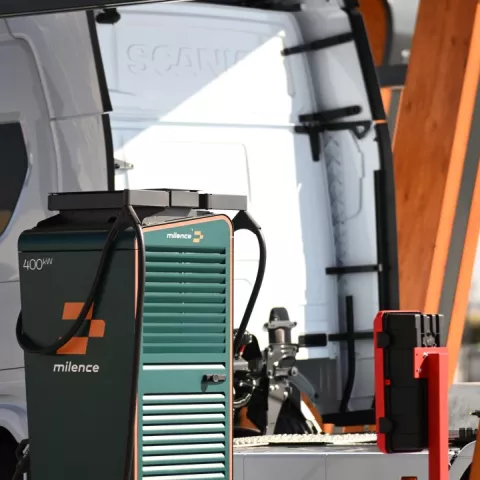
One key project is the development of Milence’s largest European charging station in the Port of Antwerp, equipped with 10 CCS (Combined Charging System) chargers and a recent addition of an MCS (Megawatt Charging System) charger. This MCS charger can fully charge an electric truck in just 30 minutes, supporting up to 22 trucks simultaneously.
In the Port of Antwerp, Equans also installs, operates, and maintains 24 dockside connection points on behalf of the city. This infrastructure enables inland waterway vessels and river cruise ships to connect to the shoreside electricity grid, eliminating the need for diesel generators. The solution reduces CO₂ emissions, contributes to the ecological transition of ports, and decreases noise pollution. Similar projects are underway in Ghent and Zeebrugge, further advancing the sustainability of Belgian ports.
Equans long-standing expertise, innovative technologies and the commitment of 10,000 employees reflect our pivotal role in Belgium's decarbonization strategy and demonstrate that large-scale progress toward sustainable mobility is achievable.
Rail & urban transit: powering tracks and depots
Rail and urban transit are evolving as clean, efficient power reaches critical points along the network. Equans is driving this evolution through its extensive expertise and solutions designed to fit each project’s unique needs.
Catenary wires and third-rail systems supply continuous electricity to trains and metro systems. Equans designs and implements these overhead lines and rail contacts to guarantee consistent energy flow while adhering to strict safety protocols. On routes lacking wiring, battery-hybrid trains recharge on electrified tracks and operate autonomously elsewhere, cutting emissions without disrupting schedules.
For urban transit, we upgrade trams and trolleybuses with regenerative energy systems that reclaim braking power and return it to the grid. This technology reduces electricity demand and reinforces network stability. Equans adapts existing infrastructure to incorporate such systems, enabling cities to maintain smoother, greener fleets.
At depots and along rail corridors, Equans installs charging stations, power distribution units and intelligent monitoring solutions. This setup ensures efficient train recharging during off-hours while integrating infrastructure with local grids and renewable energy sources. The result means a much more resilient approach to transport electrification.
Heavy road transport: electric freight hubs
Freight lorries play a key role in daily deliveries of essential goods but are also major contributors to transport emissions. Electrification offers a powerful opportunity to transform roads, reducing both sound pollution and carbon output—an initiative we proudly drive forward.
To tackle the challenge of decarbonizing mobility, Equans is partnering with Aéroports de Paris to deploy, operate, and maintain Electric Vehicle Charging Infrastructure (IRVE) at major French airports, including Paris-Orly, Paris-Charles-de-Gaulle, and Paris-Le Bourget business airport. These charging stations are strategically placed across public areas, such as VTC, taxis, and airport customers, as well as on private sites reserved for administrative staff, management, ADP employees, and service vehicles in areas like fire stations and customs. To date, 500 charging points have already been deployed, with Equans teams overseeing the entire value chain. The kiosks deliver 3.7 kWh under normal load and can provide up to 150 kWh for taxis and other users with higher energy demands.
Expanding this expertise, Equans is also working with Milence to create a vast network of over 1,700 high-power charging points across Europe by 2027. In Antwerp - Belgium, a newly launched high-capacity charging hub is powering the electric freight sector. Ten chargers, each capable of delivering 400 kW, can recharge up to 20 vehicles, reaching 80% capacity in under 30 minutes—reducing emissions and maintaining fleet productivity.
Customer Benefits - Our solutions maximize the efficiency of electric freight lorries, reducing downtime and facilitating fast recharging for uninterrupted operations. As our network grows, it fortifies logistics operations, boosting both their resilience and environmental stewardship.
Light mobility: everyday EV charging
The number of electric vehicles on French roads continues to grow at an exceptional pace, and the rising demand for electric and plug-in hybrids shows how incentives and informed consumers are accelerating this market transformation. Maintaining this momentum remains vital for hitting carbon reduction goals at both national and EU levels.
Widespread access to reliable charging points becomes essential as more people choose electric mobility. Expanding transport electrification means turning familiar places into everyday EV charging spots.
At Lidl supermarkets, for example, Equans Ineo has installed four 22 kW chargers for standard parking and two rapid 60 kW units for quick top-ups. Shoppers can now charge while running errands, and delivery drivers can recharge fast so they can stick to tight schedules. Beyond installing the equipment, Equans helps Lidl access government subsidies to reduce upfront costs and manages energy tariffs to keep charging affordable.
New regulations call for EV chargers in car parks, often combined with solar canopies that turn sunlight into electricity. These solar panels supply power directly to the chargers, easing the load on the grid and cutting carbon emissions. Some Lidl sites have rooftop and carport panels that generate enough energy to run their entire charging network.
This approach also extends to public infrastructure. For example, Equans is leading the deployment and operation of 4,699 charging points across 258 Indigo public parking lots throughout France, offering end-to-end services from installation to 24/7 user support. In the Occitania region, Equans manages the Révéo network, operating 2,380 roadside charge points, ensuring large-scale rollout and maintenance. At Paris airports – including Orly and Roissy Charles de Gaulle – Equans supports the deployment and operation of 500 EV chargers, meeting needs of taxis, airport staff and travellers alike.
Imagine apartment complexes or transit hubs where residents can charge beneath solar canopies. Smart energy systems can optimise power consumption and prevent overloads. Equans designs and implements these integrated solutions, uniting chargers, solar power and energy management into seamless, user-focused setups.
Unlocking opportunities with transport electrification
Ports, railways, motorways and car parks all connect to create the backbone of sustainable transport, and transport electrification plays a key role in cutting emissions across these areas, bringing real environmental benefits. Equans helps make this happen with end-to-end solutions – from planning and design to ongoing management – to support smoother, greener mobility.
From providing on-shore power connections at seaports to upgrading rail infrastructure, enabling electric freight on highways, or installing charging stations in everyday locations, our integrated approach is turning sustainable transport into a practical reality.
A detailed audit can reveal new opportunities within your transport network, and pilot projects allow ideas to be tested on a manageable scale, gaining insights before wider rollout. With our hands-on experience and proven expertise, Equans is ready to support your transport electrification goals.