
With Night Tracking, Equans uncovers buildings’ hidden energy consumption
Between 5% and 15% savings: that is the impact of Night Tracking on buildings’ energy consumption, depending on their type, equipment and age.With Night Tracking, Equans uncovers buildings’ hidden energy consumption
Between 5% and 15% savings: that is the impact of Night Tracking on buildings’ energy consumption, depending on their type, equipment and age.
What is Night Tracking?
Literally meaning “night-time monitoring”, Night Tracking is a service embedded in most of our Facility Management contracts. It is delivered by a dedicated team of around forty people, including 25 energy managers.
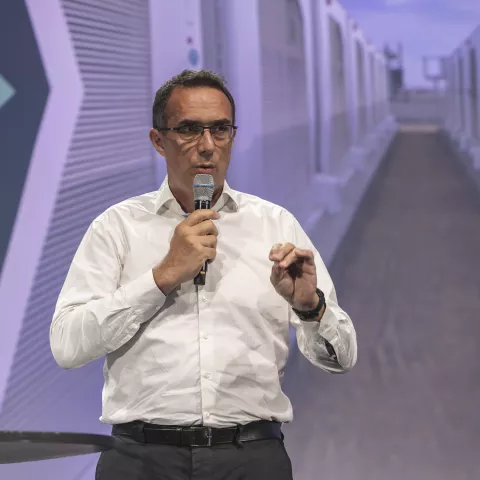
“When you add up nights, weekends and public holidays, a building is unoccupied more often than it is occupied,” explains Mathieu Joly, Head of Energy and Carbon Performance at Equans Services Bâtiments & Infrastructures (an Equans France entity).
This observation gave rise to a real hunt for waste - and for CO- now deployed across nearly 250 contracts, representing more than 3.000 buildings.
Everything starts with the contractual energy performance commitments that bind Equans to most of its Facility Management clients. “We are required to optimise energy consumption and are under strong pressure on this topic, with bonus–malus mechanisms calculated at the end of the year,” continues Mathieu Joly. “All this while we are generally asked to deliver results with little or no capital investment.”
What might seem straightforward therefore turns into a real treasure hunt, where ingenuity is essential. To meet this challenge, Mathieu Joly’s teams have developed two distinct operating methods.
Two operating methods to monitor building energy consumption
The first relies on data in a fairly traditional way. “In tertiary buildings, electricity consumption is generally recorded every ten minutes. We can easily cross-reference occupancy data with consumption during occupied periods, as captured in our energy dashboards, which provides an initial analysis,” explains Mathieu Joly.
“However, this approach lacks precision. More data is needed to build reliable models and deliver accurate diagnostics.
Some buildings are also equipped with sub-meters. In these cases, we are able to identify, zone by zone or floor by floor, which uses – lighting, heating, air conditioning, IT equipment – continue to operate unnecessarily. When this is not the case and visibility is too limited, we sometimes go directly on site to check whether timers, plant rooms or equipment are still running.”
In all cases, this level of granularity enables optimisation that is far from negligible.
The second operating method goes one step further and is based on artificial intelligence. More recent and currently in the testing phase, this approach applies to buildings equipped with a Building Management System (BMS), representing between 5% and 10% of the portfolio managed to date. The BMS is connected to a generative model – such as Akila3D, our partner, or Thermosphr – to generate predictive indicators and automatically steer energy performance towards net zero carbon.
The Bouygues building located on the CentraleSupélec campus operates under this model, achieving optimisation levels of around 15%.
Essential to optimising energy performance in tertiary buildings, Night Tracking is gradually expanding its scope to include water consumption (particularly leak detection), gas consumption and industrial sites. Each time, the ambition remains the same: to deliver an immediate and tangible impact on energy bills and environmental footprint.
Night Tracking in 3 key points
1. Up to 15% energy savings
By analysing periods of non-occupancy (nights, weekends and public holidays), Night Tracking identifies unnecessary consumption. It is already deployed across 250 contracts, covering more than 3,000 buildings.
2. Two complementary approaches
Cross-analysis of occupancy and consumption data, or an AI-based approach for buildings equipped with a BMS connected to predictive models (Akila3D, Thermosphr).
3. A growing impact
The solution is now being extended to water and gas consumption, as well as industrial sites, with a clear objective: reducing energy costs and carbon footprint — starting today.