

What is a smart airport?
What is a smart airport?

A Simple guide to a complex transformation
As global air traffic continues to rise, airports are being pushed to transform. By 2037, the number of passengers worldwide is expected to reach 8 billion. This acceleration comes with new expectations: faster and smoother travel, higher safety standards, and effective actions to urgently reduce carbon emissions.
Airports operate in an increasingly fast-changing environment where operational excellence, passenger satisfaction, and environmental responsibility must all be achieved simultaneously.
A smart airport is not just a connected terminal. It is a data-driven ecosystem where physical infrastructure and digital systems work together to improve how people move, how operations run, and how energy is used. It enables airport authorities to act with more precision, more foresight, and more flexibility.
At Equans, we believe the smart airport is not a concept. It is a concrete response to the three major transitions shaping our industry: digital, energy, and industrial. Our teams support airports in delivering safer flows, smarter systems, and more sustainable operations.
But what makes an airport “smart”? Let’s take a closer look.
Understanding the Smart Airport: key capabilities explained
Smart operations: technology for performance and resilience
These technologies support everything passengers don’t see: the systems that keep the airport running safely and efficiently, even in complex or high-pressure situations.
Internet of Things (IoT)
The IoT connects physical devices (like sensors or counters) to share live data across airport systems. This can include anything from air conditioning and lighting to baggage belts or occupancy levels in terminals.
With this data, teams can monitor operations in real time and act faster to correct problems or avoid breakdowns.
Artificial Intelligence (AI)
AI uses data to help airports make better decisions. It can detect unusual activity, predict when equipment might fail, or help adjust staffing to match passenger flows. By automating analysis, AI turns raw information into useful insights, saving time and increasing reliability.
Digital Twin
A digital twin is a virtual copy of the airport and its systems, constantly updated with real data. It allows operators to test ideas, simulate disruptions, or optimise energy use, without interrupting daily operations. Used well, it helps teams anticipate issues and manage the airport more proactively.

Equans supports 24/7 baggage handling operations at YUL through Air’NG, a secure cloud-based platform combining IoT, AI, and real-time dashboards.
The system monitors every component of the baggage system (including sorters, conveyors, and check-in counters) and predicts failures before they occur.
It enables faster incident response and improves operational uptime for 40 airlines.
The result: 30% more baggage processed and critical faults reduced.
Smart Travel: enhancing the passenger experience
A smart airport also means a better journey for passengers. Digital tools help reduce wait times, simplify processes, and make each step more intuitive from check-in to boarding.
Passenger Flow Management
Passenger flow systems use sensors like LiDAR or video analytics to detect how people move inside the terminal. They help airport teams understand where congestion is forming and respond in real time, by opening more checkpoints, for example, adjusting signage, or redirecting flows. The aim is simple: reduce friction and make movement through the airport smoother and more predictable.
Biometrics
Biometric systems identify people based on physical traits, such as facial recognition or fingerprints. By automating identity checks, they speed up processes like boarding or passport control while improving security. For travellers, it means fewer documents to handle and less time spent in queues.
Real-Time Information Systems
These systems keep passengers informed throughout their journey. Flight status, gate changes, estimated waiting times… all updated instantly. Information is shared through screens, mobile apps, or connected kiosks, helping travellers make decisions more easily and stay in control of their journey.
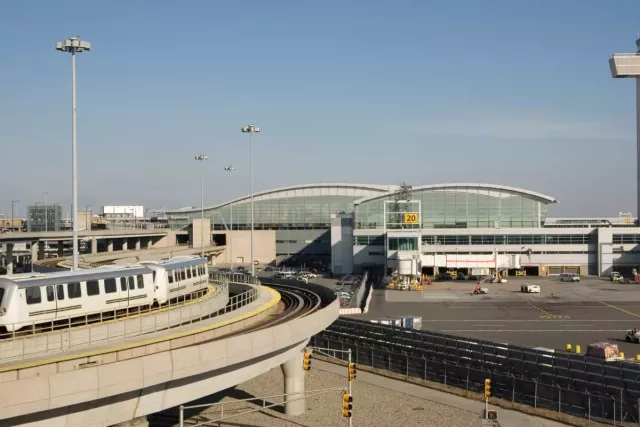
Since 1997, Equans has supported JFK with key systems including CCTV, check-in kiosks, and digital signage. More recently, the airport has integrated passenger flow management systems to monitor occupancy and optimise operations.
Equans is currently testing next-generation LiDAR technology through its R&D centre to further enhance accuracy and real-time responsiveness.
Smart Sustainability: technologies that support greener airports
Sustainability is no longer optional, but a priority. Airports are expected to reduce emissions, limit energy use, and shift to more responsible operations. Smart technologies can accelerate this transition without compromising performance.
ATES (Aquifer Thermal Energy Storage)
ATES is a geothermal solution that uses underground water to store and supply heat or cooling for buildings. In airports, it helps regulate terminal temperatures while significantly cutting energy consumption. It’s a long-term investment that supports carbon neutrality and reduces dependence on fossil fuels.
PCA (Pre-Conditioned Air Unit) and 400Hz Power Supply
When aircraft are parked at the gate, they usually rely on onboard engines to stay powered, which burns fuel and generates emissions. PCA units and 400Hz ground systems provide clean air and electricity directly from airport infrastructure. This helps limit fuel use on the ground and improves air quality around the terminal.
SAF (Sustainable Aviation Fuel)
SAF is a new generation of aviation fuel made from renewable sources like waste oil or biomass. Used in place of conventional jet fuel, it cuts lifecycle CO₂ emissions and doesn’t require aircraft to be modified. While SAF adoption depends on airline policy, airports play a key role in enabling its supply and distribution.
Scope 3 Emissions
These are all the indirect emissions linked to airport activity: for example, from passenger transport to and from the airport, or from suppliers and subcontractors. Reducing them requires collaboration beyond the terminal: with local authorities, mobility operators, and the wider territory.
To support Schiphol’s climate strategy, Equans deployed Aquifer Thermal Energy Storage (ATES) systems coupled with a full digital twin of the terminal infrastructure.
ATES saves 625,000 m³ of natural gas annually, while the digital model integrates live data from over 80,000 assets for predictive maintenance and energy management.
This combined approach improves performance, reduces emissions, and supports long-term decarbonisation.
Key takeaways
- A smart airport is a practical response to the three transitions reshaping aviation: digital, energy, and industrial.
- Technologies like IoT, AI, and digital twins help operators monitor systems in real time, predict failures, and optimise resources.
- For passengers, smart solutions such as biometric ID, flow tracking, and live information improve the travel experience at every stage.
- Sustainability is supported through innovations like geothermal systems (ATES), ground-based power (PCA, 400Hz), and the integration of sustainable aviation fuels (SAF).