

How is air managed in a submarine?
How is air managed in a submarine?

A submerged submarine is a sealed world. Once the hatch closes, everything the crew needs to breathe, stay comfortable and remain operational must be generated, managed and maintained from within. Here's how it works, from the systems that keep the crew alive to the frameworks that keep those systems certified across decades of service.
Key takeaways
- Submarine air management is active, not passive: multiple interdependent systems must run continuously to keep the crew alive and the vessel operational.
- HVAC design on submarines is shaped as much by acoustic constraints as thermal ones, because noise means detection.
- DGA qualification governs not just how these systems perform on day one, but how they're maintained across 30+ years of service life.
- CO₂ scrubbing and oxygen generation are survival-critical: without them, a submerged crew has hours, not days.
- The snorkel cycle is a tactical decision as much as a technical one: every surface event creates a radar signature.
What the crew needs, and what happens without it
Air management in a submarine starts with two non-negotiables: removing what the body produces, and replenishing what it consumes.
CO₂ scrubbing
Every breath the crew exhales adds carbon dioxide to the hull atmosphere. Without continuous removal, CO₂ concentrations can reach toxic levels within hours. Scrubbing systems filter the air through chemical absorbents (typically monoethanolamine or lithium hydroxide) capturing CO₂ and returning clean air to the crew space. Managing this system means tracking absorbent saturation, scheduling replacements without interrupting airflow, and maintaining redundancy: on a long patrol, the logistics of how much absorbent is carried can become an operational constraint in itself.
Oxygen generation
Removing CO₂ solves only half the problem: oxygen must also be actively replenished. The primary method on nuclear submarines is electrolytic oxygen generation (EOG): electrical current splits water molecules, feeding oxygen back into the atmosphere and venting hydrogen overboard. On conventional submarines with limited battery capacity, managing the balance between power consumption and atmospheric oxygen levels is a genuinely delicate equation. Chemical oxygen sources (oxygen candles) serve as backup, but require strict storage and handling protocols, as they generate significant heat when activated.
Managing the environment aboard
Once the atmosphere is breathable, the next challenge is making it liveable, and protecting the equipment that the crew depends on.
Staying undetected
Every mechanical system on a submarine generates vibration. Fans, pumps, compressors, duct joints: each contributes to the vessel's acoustic signature, the sum of all sounds it produces and one of its primary tactical vulnerabilities.
Managing acoustic performance is not a one-time design decision. Resilient mountings degrade, bearings wear, connections loosen. Maintenance programmes for HVAC and air systems therefore include systematic acoustic testing - not just functional checks - to catch degradation before it affects the vessel's tactical profile. A submarine that is mechanically sound but acoustically compromised is an asset operating below its potential.
Breathing again: the snorkel cycle
Conventional submarines cannot generate oxygen or expel CO₂ indefinitely without some connection to the surface. The snorkel mast, a retractable tube extending just above the waterline, allows the vessel to run its diesel engines and renew its atmosphere at periscope depth, without fully surfacing.
Managing the snorkel cycle means maintaining the head valve (which must close automatically if submerged by a wave), coordinating timing with battery charge levels and atmosphere renewal needs, and making a tactical calculation: the mast creates a radar signature, so every snorkel session is a compromise between operational necessity and exposure. The frequency and duration of these cycles is one of the variables that shapes how long a conventional submarine can remain on patrol.
Keeping it all working, for decades
The systems described above must not only perform on day one, they must remain qualified, maintainable and serviceable across the full service life of the vessel. For a nuclear submarine, that can mean 30 years or more.
Pressure hull integrity
The sealed structural shell within which all life support systems operate requires continuous monitoring: inspections of seals, penetrations and welds, fatigue tracking across the service life, and a documented approval process for every modification, however minor.
DGA qualification
In France, systems installed on naval platforms must meet the qualification standards of the DGA (Direction Générale de l'Armement, the French defence procurement agency). This covers not just initial performance but maintainability over time. Every component replacement, every system upgrade, must be demonstrated not to compromise the original certification. Rebuilding that qualification history after a contractor change adds time and complexity to a maintenance programme — one of the reasons defence operators often prioritise continuity with their maintenance partner on long-life platforms.
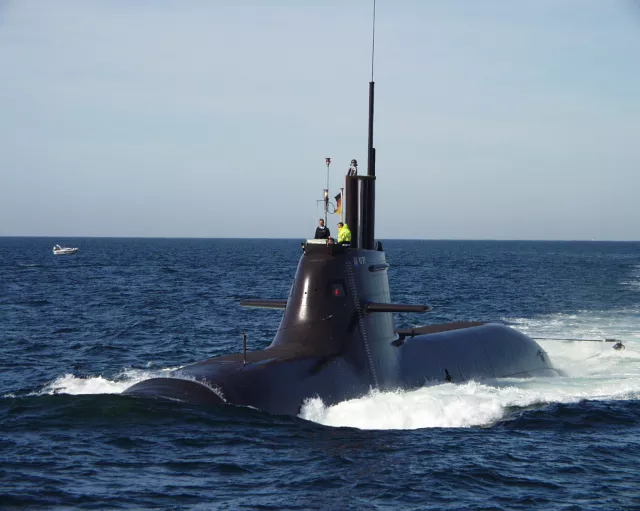
Design and supply of the full ventilation network for France's new generation of nuclear attack submarines, to the exacting specifications of the Barracuda programme.
- 34,000 m³/h of fresh air supply across the vessel
- 28,000 m³/h of pollutant extraction capacity
- System resistant to seismic risk and pressure wave
- Single contractor across the full project value chain (2022–2026)
Go further


Still have questions about submarine air management?
With fully functioning CO₂ scrubbing and oxygen generation, a nuclear submarine can theoretically remain submerged indefinitely from an atmosphere standpoint. In practice, patrols are limited by food supplies, crew endurance and mission parameters, not air.
Power. Nuclear submarines have unlimited electrical capacity, so they can run EOG and scrubbing systems continuously without compromise. Conventional submarines manage a constant tension between battery charge levels and atmosphere renewal needs, which is why the snorkel cycle is a central operational discipline.
Crews fall back on chemical oxygen candles and portable CO₂ absorbent canisters as emergency backup. Simultaneously, the vessel will typically move to abort the patrol and surface or proceed to the nearest support point. Redundancy is engineered into these systems precisely because there is no equivalent of calling for help from depth.
Directly: more crew means more CO₂ produced and more oxygen consumed per hour. System capacity is sized for the maximum crew complement, with safety margins built in. On longer patrols, consumable management (absorbent stocks, oxygen candle reserves) becomes a logistical calculation that feeds into mission planning.