
BESS: Battery energy storage system
More buildings now run on electricity, and solar panels keep popping up. The power grid has more to handle — and more ups and downs. Since solar and wind don’t produce energy on demand, the system needs to stay flexible and keep everything in balance, every hour of the day.
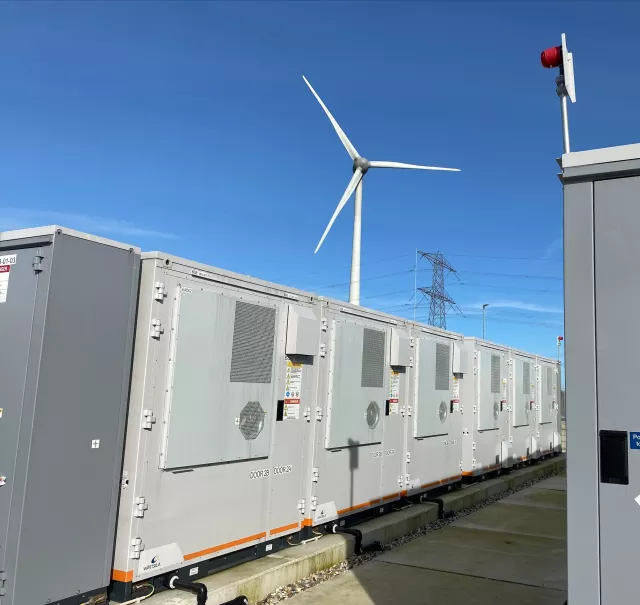
Energy storage shifts electricity from surplus to shortage periods, keeping power flows stable and predictable. This flexibility supports the energy transition and keeps grids steady as more renewables connect.
A BESS (Battery Energy Storage System) offers a practical way to manage this shift. The units absorb power during low-demand windows and discharge it during supply gaps. They support solar roll-outs, reduce stress on cables and substations, and open up new options for public and private operators.
As energy demand changes and solar adoption grows, a BESS offers a way to keep the grid steady. It has moved from pilot use to large-scale deployment, backed by stronger returns and improving battery technology.
What is a battery energy storage system?
A battery energy storage system is a technology that stores electricity for use when it's most needed. It helps to match energy supply with demand, especially when working alongside solar power and other variable sources. A BESS provides more control by decoupling when energy is produced from when it’s used.
Each BESS is made up of several components. Battery modules — most often using lithium-ion chemistry — store the energy. An inverter converts the direct current (DC) from the batteries into alternating current (AC), which powers equipment or feeds the grid. Control systems manage safety, performance, and how and when the batteries charge and discharge. Cooling infrastructure protects the system from overheating and keeps performance stable.
Most BESS installations are modular and scalable. They vary in size and configuration, from large, centralised assets that support electricity grids, to smaller on-site systems installed near buildings or solar farms. Hybrid systems combine a BESS with solar generation to provide additional stability and support.
Today, lithium-ion remains the leading technology for battery storage due to its high energy density, fast reaction time and improving cost profile. However, other chemistries such as flow batteries or sodium-ion are being explored for long-duration storage needs.
Performance is usually measured in terms of storage capacity (in MWh), power output (in MW) and cycle life, each matched to the specific needs of the user. Integrated digital platforms help businesses to monitor system performance, automate charging cycles and manage energy more effectively.
How BESS technology works with renewables
Solar power often produces more electricity than needed during daylight hours. Without a way to capture this surplus, the energy goes unused. A BESS stores excess solar generation and makes it available when demand rises — at night, during cloudy weather or when the site load increases.
This process is known as time-shifting. By moving energy from one part of the day to another, BESSs reduce reliance on the grid. In business terms, this translates to cost savings and improved site independence. Peak shaving is another key benefit. During periods of high consumption, the BESS discharges stored power to avoid expensive peak charges. The result is a smoother load profile and better energy management.
BESS technology also adds a layer of backup power. In the event of a power cut, businesses can maintain operations and protect sensitive equipment. Combined with solar, this setup forms a robust, low-carbon energy system.
Industrial sites and business campuses increasingly use solar-plus-storage systems to balance energy flows and stabilise operations. For example, manufacturing facilities store battery energy to support high-consumption machinery, while office parks time-shift solar power to cover early evening demand. This flexibility reduces emissions and provides more control over storage power needs.
Integrated solar and storage systems support organisations aiming to reduce operational costs, secure uptime and contribute to the shift towards renewable energy. Equans was recently selected to deliver a large-scale battery energy storage system at the Maxima power plant in Lelystad, Netherlands. This project exemplifies Equans' expertise in delivering complex, large-scale battery energy storage systems that support grid stability and the integration of renewable energy.
Types of BESS technology
Lithium-ion leads deployment across BESS projects. Its high battery energy density, competitive cost and strong operational history — especially in the electric mobility sector — have positioned it as a reliable option across a range of applications. With round-trip efficiency reaching 90–95%, it supports daily cycling in solar power installations. Advanced cooling ensures thermal stability and extends service life, while its compact format suits sites with space limitations.
For longer discharge or reduced wear from repeated cycling, alternative chemistries offer distinct advantages. Flow batteries separate energy and power functions via external electrolyte tanks. This structure supports up to 10,000 deep cycles with minimal performance loss, aligning with energy storage projects that require sustained output. However, they demand more footprint and involve higher capital expenditure.
Solid-state batteries continue to gain attention due to their non-flammable composition and the potential for higher projected energy density. Most remain in pilot stages, but their safety profile and potential footprint reduction present promising future applications. Sodium-ion batteries use widely available materials, supporting supply chain stability and lowering input costs — valuable considerations for long-term renewable energy integration.
Hybrid BESS configurations now combine technologies to match site-specific goals. For instance, lithium-ion manages rapid cycling, while flow batteries handle extended backup power. Each configuration addresses different needs depending on site constraints, round-trip efficiency targets, cycling frequency and broader energy management strategies.
Typical business applications for BESS
BESS technology adapts to the operating patterns, risks and energy flows of different industries. The following examples explain how storage is applied to improve uptime, cost control and energy use.
Manufacturing and industry
Industrial operations rely on stable, high-capacity electricity supply to maintain productivity. In facilities where demand fluctuates sharply — such as during equipment start-up or high-load shifts — a BESS lowers exposure to peak-time tariffs by storing energy when rates are lower and discharging during more expensive periods.
The system improves power quality and mitigates micro-interruptions, which can otherwise trigger shutdowns or damage sensitive equipment. When paired with on-site solar or other renewables, BESS technology enables more consistent power flows by managing intermittency at the source. It also supports power factor correction and harmonic filtering, contributing to more efficient interaction with the grid.
Retail and logistics
Retail parks, warehouses and logistics hubs equipped with rooftop solar gain significant operational value by integrating battery energy storage. Midday solar output can be stored and released later in the day to support extended working hours, offset peak tariffs and reduce drawdown from the grid during demand spikes. In temperature-controlled environments like cold-chain facilities, battery energy storage systems improve load stability, preventing costly energy fluctuations.
During periods of high throughput or seasonal demand, storage systems ease pressure on local distribution networks and maintain steady power availability. A BESS also enables facilities to participate in grid flexibility programmes or secure behind-the-meter optimisation, aligning site operations with broader energy efficiency goals.
Data centres and tech infrastructure
Downtime is not an option. Battery energy storage systems deliver a near-instantaneous response during power disturbances, bridging gaps before auxiliary systems engage. They also reduce reliance on diesel generators, thereby lowering operational costs, emissions and maintenance cycles.
BESS technology also manages power imbalances caused by fluctuating server loads, supporting consistent voltage and frequency levels. This improves equipment lifespan and power quality across mission-critical systems. When paired with solar PV, storage offers added autonomy and better energy planning.
Public sector and healthcare
Hospitals, emergency services and public facilities require uninterrupted access to power. BESS technology supports this by providing instant backup during outages, maintaining critical operations such as surgical units, intensive care and communication infrastructure. For sites equipped with on-site solar, a BESS addresses load-shifting challenges by storing surplus generation for later use.
Systems are often configured to meet specific load profiles and cycling requirements, ensuring continuous availability of clean energy during peak periods, maintenance windows or emergencies. In healthcare settings, integration with building energy management systems also supports compliance with strict operational and safety standards
Energy producers and IPPs
Large-scale solar installations often generate surplus electricity that exceeds immediate grid capacity. Battery energy storage systems retain this surplus for controlled discharge during high-demand periods or frequency deviations.
Co-locating a BESS with generation assets improves energy delivery precision and supports grid-balancing efforts. It also allows producers to participate in capacity markets and time-shift exports for price arbitrage. The ability to deliver firm, dispatchable power strengthens the commercial viability of intermittent renewables and enables IPPs to meet contractual obligations under Power Purchase Agreements (PPAs) more reliably.
Equans designs solar-plus-storage systems for commercial and industrial sites, combining a high-efficiency BESS with site-optimised solar power arrays. Each solution integrates advanced energy management tools that support load balancing, cost reduction and seamless interaction with the electricity grid. Businesses benefit from improved backup power capabilities, lower exposure to peak tariffs and a stronger role in the renewable energy transition.
FAQ – common questions about BESS
A BESS stores electricity for use when demand is high or generation is low. It supports energy stability, especially during peak times or outages, and allows organisations to shift consumption patterns.
Initial investment varies based on battery capacity, discharge duration, chemistry type and control architecture. Installation and commissioning costs also depend on site conditions and grid interconnection requirements.
Over time, businesses may see savings through reduced peak demand charges, improved energy arbitrage, time-shifting and access to revenue streams from frequency regulation and other ancillary services.
Key considerations include storage capacity, discharge duration, response time, expected lifespan and compatibility with existing systems such as solar PV or backup generators. Site layout, available footprint, ambient temperature and cooling requirements can influence system configuration.
Maintenance protocols, battery management systems, safety certifications and grid connection standards also shape technology selection.
BESS projects support the grid by delivering fast-response services such as frequency regulation and voltage control. They reduce fluctuations from renewable generation, maintain power quality and supply active and reactive power when needed.
Battery storage supports the energy transition by making renewable energy more reliable. While ion batteries require careful end-of-life handling, lifecycle emissions are lower than fossil-based alternatives
Conclusion: BESS as a foundation for decarbonisation
Battery energy storage systems give organisations enhanced control over electricity flows. Solar generation gets stored and used when demand peaks, turning an intermittent source into a steady supply. As energy networks grow more dynamic, a BESS offers a stable, low-carbon alternative to traditional infrastructure.
Energy storage prepares infrastructure for a renewables-driven model. Sites benefit from greater autonomy, tighter cost control and a reliable way to meet carbon targets. In sectors where demand and pricing keep rising, BESS technology fits into long-range planning for renewable driven operations.
Equans works with industrial and public sector clients to deliver large-scale solar-plus-storage. From design through to operation, our teams deliver integrated systems built for performance and long-term value.